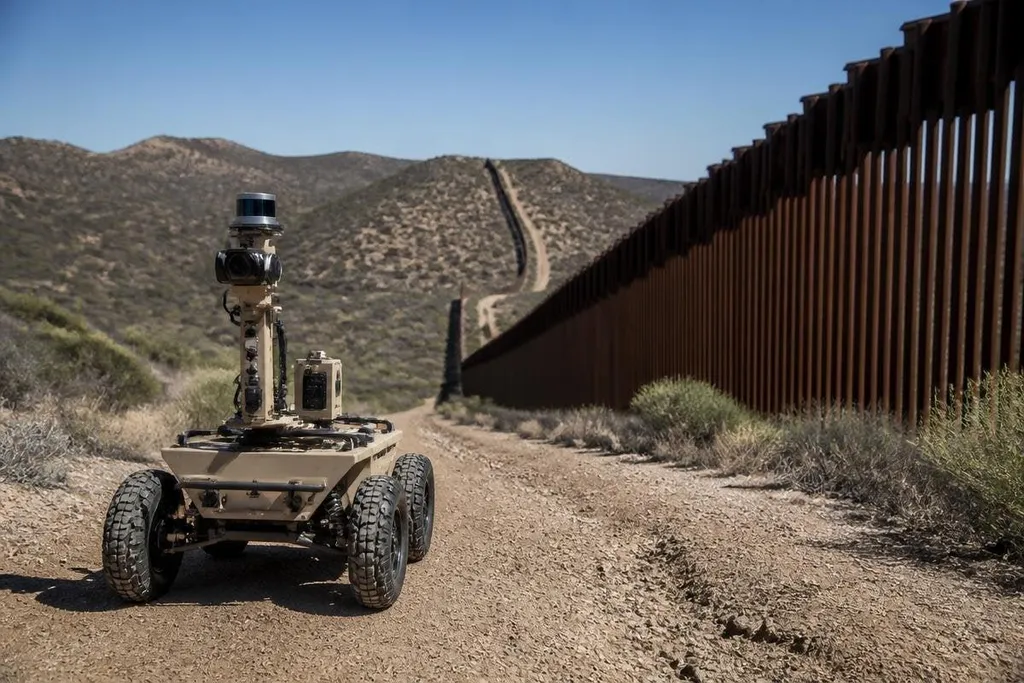
A border robot could watch a remote crossing for hours, carry a camera along a fence, or send an alert when a sensor detects movement. The hard question is not whether the machine can spot activity. It is whether people can check its decision before that alert changes someone’s life.
Quick read
- Cameras, thermal sensors, LiDAR, and ground sensors can collect different kinds of border data.
- Remote operation can keep staff away from steep ground, extreme heat, or other hazards.
- Human review, clear records, and strict limits matter more than a robot’s speed.
What the robots would do
The border control system could combine several machines rather than rely on one patrol robot. A ground robot might carry cameras and LiDAR, which measures distance with laser pulses. A drone could inspect a long fence line, while fixed sensors watch a narrow pass.
Each tool sees a different part of the scene. A camera can record a person, vehicle, or damaged fence. Thermal imaging can show heat at night, but it can also confuse people with animals or warm rocks. LiDAR can map objects and ground shape, though dust, rain, and vegetation can affect its readings.
That data could reach a control room where staff decide what happens next. The robot may report a location and time, but a person would still need to check the image, assess the setting, and choose a lawful response.
Where automation could help
Remote areas create a basic safety problem. Staff may need to inspect rough ground, unstable slopes, or long stretches of fencing. A robot could send video before a person travels to the site, reducing unnecessary trips and giving staff more context.
A machine can also keep watch during periods when staffing is thin. That does not mean it can replace judgment. It means the system may point staff toward a location instead of asking them to search a wide area without a lead.
The value depends on the full chain. A sensor must detect movement, the network must carry the data, software must sort the alert, and a trained person must review it. A failure at any point can turn a useful warning into a missed event or a false alarm.
That chain also matters at a border, where a false alert can delay a traveler or send officers to the wrong place. Border control robotics coverage can tie claims about these systems to the sensor, test site, date, operator role, and recorded result before the risks are examined.
The risks are easy to miss
More sensors can mean more records about people who have done nothing wrong. Images, location data, and vehicle details may be stored, copied, or sent to another system.
A border agency would need a clear rule for what gets collected, who can access it, and when it must be deleted. That rule matters because the system can affect people who were never confirmed as a threat.
Software can also misread a scene. A system trained on one type of terrain may work less well in another. Poor light, weather, clothing, crowding, and partial views can all change what the camera sees. An alert is a request for review, not proof of illegal activity.
The system should also show its work. Each alert needs a time, location, sensor source, operator action, and final result. Those records let supervisors check errors and give affected people a way to challenge a decision.
A remote operator needs control over the machine. That includes a stop command, a clear handoff to another operator, and a plan for lost network access. A robot that keeps moving after contact fails is a safety problem, even if its sensors work as designed.
What remains unproven
The public case for border robots often rests on a short demonstration. That can show movement, video quality, or remote control. It cannot show how the system performs across months of weather, repairs, network outages, changing terrain, and busy crossings.
Cost also goes beyond the robot. Agencies would need charging equipment, spare parts, secure networks, software updates, staff training, maintenance, and rules for data access. A machine that sits unused after a broken sensor does little for border safety.
I’d keep autonomous decisions away from detention, search, or force. A machine can help find a place for a person to look, but the final action needs a named human decision-maker and a record that can be reviewed.
A practical test before purchase
An agency assessing a border robot should ask:
- Detection: Name the objects it can identify and record how weather changes its results.
- Review: Can a trained person see the source video before acting?
- Control: Can staff stop the machine when the network drops or the scene changes?
- Records: Does the system log alerts, decisions, access, and deletion dates?
- Failure: What happens when a sensor, battery, map, or radio link stops working?
- Proof: Has the maker shown long field trials in the terrain where the robot will run?
These checks shift the focus from a robot’s movement to the decision process around it. That is where public safety, privacy, and accountability meet.
Border control robots may help staff watch difficult ground, but their value will rest on error rates, human review, and records that survive scrutiny. Until agencies publish that evidence from real deployments, the sensible role for the machine is an extra set of sensors, not the final authority.